RaypersonNikol wrote: Sun Apr 05, 2026 3:15 am
Here's mine that would 100% light me on fire on other Rayman social media spaces:
30th Anniversary Edition does not deserve the hate it got and I will die on that hill. I genuinely wish people would look past the OST debacle (which is now starting to irritate me every time I see someone talk about R30AE, like I get it, you want the original OST back, what else is new) and realize it's now accessible on MODERN HARDWARE and is actively getting bugfixes and stuff.
I don't think people should simply stay silent and accept the tampering with a rerelease. You wouldn't want to, say, watch Star Wars with an entirely different score that changes the tone the original music had. Just because UbiShart was willing to change the music because of royalties, that doesn't mean we should go along with them and be ok with it.
Well, here's the thing, and I literally forgot about everything until you replied to me, so thanks for making me remember it again when I really didn't want to!:
Not all of the original soundtrack was entirely composed by Remi Gazel. Remi only did a few tracks, the rest was by other composers that were on the team at the time, if you look at the credited people. Remi already gave the go ahead to use his music. It's the rest of the composers that are the issue with getting permission, as we don't know if 1. Ubisoft still has contact with them, or 2. Ubisoft has already asked, but got told no, and thus Christophe Heral was assigned to remake the tracks that aren't Remi's. Remi's tracks are still intact with barely anything done to them, it's the other composers' tracks that were remade.
Also not saying ya'll should be silent, I'm just saying that it was getting irritating to see (and hear) the same stuff. That's *my* hang-up, not anyone else's, but thanks for replying to me specifically two months later. I'd rather not beat my own dead horse, cuz it was *my* opinion at the time. This forum is called "unpopular opinions" for a reason, friend...
Please stop beating the dead horse, it's already beaten up enough, I BEG YOU!! D': Please, it's had enough, it's ALREADY DEAD lol
Origins не была катастрофой. Во всяком случае если говорить о нимфах. Редизайн тот же Бетиллы был классным и это в десятки раз лучше классики. Не, конечно оба дизайна обладают своим шармом, но всё же дизайн как Бетиллы, так и её сестёр-нимф — это одна из вещей, из-за которых стоит сыграть в эту игру. Тем более художники до сих пор рисуют Бетиллу если не в купальнике и юбке, то уж точно нарисуют на щеках веснушки и обязательно длинные рыжие волосы, которые длиннее её.
Что касается самой игры и прочего... Ну Юбики как всегда думают что если не начать рисковать, то всё — идея будет плохой. Только вот потенциальные покупатели, среди которых в основном являются именно фанаты серии, хотят получить что-то сказочное и прекрасное, а не цветастый рендер который сделали на Blender за несколько дней. Могли бы в таком случае вообще не идти в 3D, ибо серия Рэймана очень хорошо выглядит как 2D (пускай со второй части серия в основном двигалась именно как 3D платформер), тем более вся атмосфера и сеттинг мира прям подталкивает к данному решению. Мишель Ансель работал над серией с душой, а сейчас этого в Ubisoft очень сильно не хватает.
Я в целом не поддерживаю мнение фанатов о том, что придёт папочка Гиймо и сделает нам сиквел. Но для этого нам просто нужно подождать, ведь "Всё идёт по плану". Ага. По плану. Люди хоть понимают, что Rayman в первую очередь для Ubisoft это не игра, а бренд, за счёт которого компания и обогащается? Им важно только получить деньги за продвигаемый продукт, а не выпуск этого продукта. И именно так рынок и работает. Поражает порой меня то, как очень много людей чуть ли не на полном серьёзе говорят, что вот купим мы Legends Retold — тут же Rayman 4 выйдет. Такого не будет. Скорее какой-нибудь фанат выпустит любительскую игру, в котором будет больше механик, чем могут предложить официалы. Вот и живём мы с тем, что будущее у серии крайне сомнительное и очень мало кто будет доволен всем.
dr_st wrote: Tue Jul 21, 2026 7:24 pm
Oh, Warcraft II is such an awesome game! I only played the DOS version, though, and only against the AI.
The DOS version has a bug with the Death Coil and Death & Decay icons being switched. It bugged me so much that I fixed it.
Ah, I see what you mean. I even play DOS version a bit, but then I moved play War2BNE/War2Combat instead.
DOS version requires CD inserted if you click Single Player Game or Replay Introduction. Even though, the Multi Player Game says that can also join game who do have Warcraft II CD. But in the Shareware version, you also able play one player or multiplayer game (shareware demo version had restriction because single player custom scenario is absent).
Interestingly, Warcraft II DOS version also works fine in DOSBox too.
Hunchman801 wrote: Sun Jul 19, 2026 11:09 pm
Congratulations to Spain on winning their second star! It was a well-deserved victory. They truly outplayed everyone out there. The Argentinian goalkeeper was incredible, though. They would have lost 10-0 without him.
Agreed. I started watching the match with a small preference for Argentina, but towards the end I realized that if they won, I would feel bad because they really did not deserve it with how the game unfolded.
With that said... zero (yes, let that sink in, ZERO) Argentinian chances until 117th minute, and then two chances during the last few desperate attempts.
It wasn't as far as one may think for a game that should have ended 6-0, to have ended 1-1. I witnessed such a game live once, albeit it was just a local league game, and nothing of importance.
The Argentinian goalkeeper Martinez deserves all the praise. But don't forget Spanish goalkeeper Unai Simon's excellent rushing out to an accidental pass in the 5th minute. If he hadn't been paying attention, Spain could have been in big trouble.
DaveRattlehead wrote: Tue Jul 21, 2026 6:28 pm
I thought it was absolutely crazy to hear Argentine conspiracy theories claiming that outside forces prevented Argentina from winning the final, or that they basically weren't even allowed to compete.
I just beat Mr. Dark in Rayman 1 on the GBC, in Rayman 30th Anniversary Edition, but now my game is stuck on the 'The End' screen. No button does anything, so how can I go to the world map, find all the cages, and unlock the Dark Legacy levels?
Welcome to Pirate-Community, the largest Rayman community!
Discover Rayman 2 Redreamed, a complete reimagining of Rayman 2 currently developed by New Dawn Games!
Show your editing skills in RPC's Manipulate the Image competition, which is now expanded to include non-Rayman images!
Participate in RPC's Signature Of The Month competition for the chance to win prizes including tings and special ranks!
Discuss speedrunning news, techniques and events in our Rayman speedrunning section!
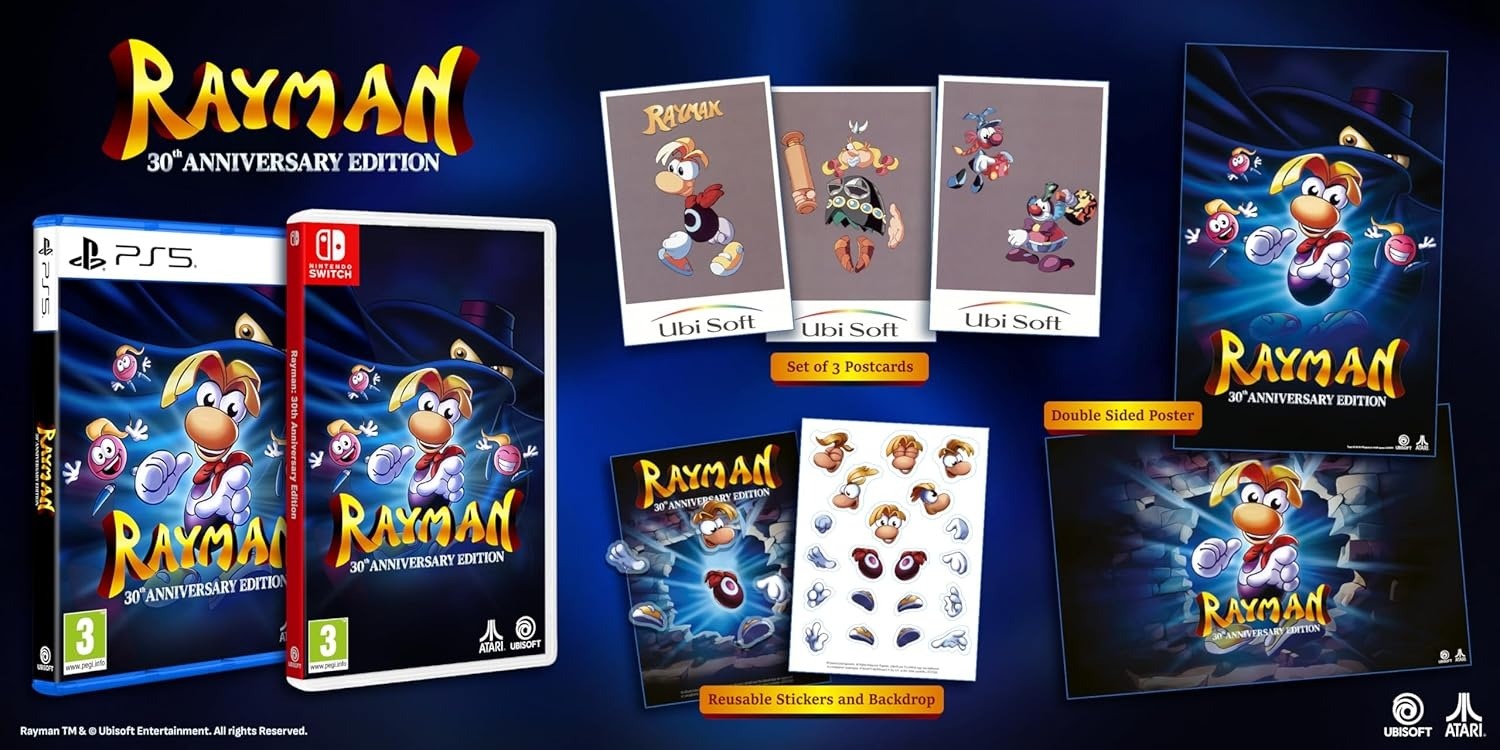
The physical version of Rayman 30th Anniversary Edition was released today.
Alongside the game for modern platforms such as the Nintendo Switch 2, this physical release includes a set of three postcards, a few stickers, a double-sided poster, and a reversible cover.
For players who held out on the digital launch due to early save-related glitches, these issues have now been resolved following the recent v1.1 update.
It's official: the rumors are now reality! Although many details leaked over the last few days, Ubisoft has formally announced both Rayman Legends Retold and Rayman Origins Enhanced Edition during tonight's State of Play presentation.
Both games are coming to PlayStation 5, Xbox Series X|S, Nintendo Switch 2, and PC on October 1, 2026! The bundle will retail at the price of $39.99, with Origins Enhanced Edition included free!
Rayman Legends Retold represents a significant modernization of the original title. It features a visual overhaul that replaces the classic watercolor look with a modern 2.5D aesthetic, alongside an entirely new storyline and a fresh villain. Other key additions include brand-new music levels, a realistic redesign for Betilla, and a minor cosmetic tweak for Rayman himself (who now has two separate eyes), along with new costumes referencing older games and other series. Most notably, the game is set to introduce fully 3D segments featuring rail-shooter gameplay, where players take to the skies on the back of a dragon to shoot down enemies.
As for Rayman Origins Enhanced Edition, running in 4K resolution at 60 FPS, this remaster updates the game for modern platforms with quality-of-life and accessibility features. It also appears to integrate the previously exclusive PlayStation Vita content, alongside updated photoboard designs and Murfy.
What are your thoughts on this? Head over to our newly opened forum topics to join the discussion and share your expectations.
Following up on the teaser from a couple of days ago, Youtooz has now officially revealed the full design of the upcoming Ly the Fairy plush!
But that's not all: the manufacturer also unveiled a brand new Rayman "stickie". For those unfamiliar with the term, Youtooz "stickies" are mini plushies equipped with magnets inside, allowing them to stick to metal surfaces (like fridges or PC cases) or to each other.
You can check out the full reveal images of both the Ly plush and the Rayman stickie below:
Collectibles manufacturer Youtooz has recently teased what appears to be an upcoming plush toy of Ly the Fairy. First introduced in Rayman 2: The Great Escape, the iconic character seems to be the latest addition to the company's growing lineup of Rayman merchandise. You can view the teaser image below:
Former Rayman 3 gameplay programmer Yann Masson has just shared early development footage of the game discovered in his personal archives. The newly surfaced video provides a fascinating look into the title's production, most notably showcasing the scrapped sequence where the Xowar chases Rayman, viewed from a frontal perspective:
What better way to celebrate the Chinese New Year than with a major milestone for our knowledge base? The Chinese version of RayWiki is officially published!
This project has been in the works for more than two years, representing a massive effort to make the Rayman universe accessible to a wider audience. To ring in the new year, the wiki launches with an impressive 400 articles already written and available.
A massive congratulations and thank you to the main contributors, RayGhox and Game Ze 2, for their dedication in bringing this project to life.
The rumors were true! After the rating leak earlier this year, Ubisoft officially unveiled Rayman 30th Anniversary Edition during today’s State of Play. Developed in partnership with Digital Eclipse, the compilation brings together five versions of the original game: the PlayStation, MS-DOS, and Atari Jaguar releases, as well as the Game Boy Color and Advance versions. The collection also marks the first official commercial release of the 1992 SNES prototype.
In terms of extra content, the package notably features the Bible of Game Design, developer interviews, and unreleased concept art. The collection also adds modern quality-of-life features, including rewind capability, save states, and toggleable cheats (infinite lives, unlock all levels).
In total there are 229 users online :: 3 registered, 0 hidden and 226 guests (based on users active over the past 5 minutes) Most users ever online was 3065 on Mon Feb 03, 2020 5:23 pm
 RayWiki is the largest source of Rayman knowledge and a community encyclopedia. Whether you're looking for information or simply feel like contributing to this great project, do not hesitate to visit our wiki.


 Ubisoft has agreed to support the event with the following prizes:


