Rayman 2 (PlayStation)
- This article is about the Sony PlayStation version of Rayman 2. For the game in general, see Rayman 2.
Rayman 2: The Great Escape for the Sony PlayStation is a remake of the game developed by Ubisoft Shanghai. Unlike other versions, which are ports from the original Nintendo 64 and PC releases, this version was remade to work with the more limited resources of the PlayStation console. Most notably this version omits several levels, combines levels and features fewer soundtracks than other versions. The graphical quality is lower as well. The soundtrack quality was however kept intact, not utilizing the lower quality MIDI one from the Nintendo 64 version.
| Rayman 2 | ||
|---|---|---|
 | ||
| Published by | Ubi Soft Entertainment, Yves Guillemot | |
| Developed by | Ubi Soft Montpellier, Ubisoft Shanghai | |
| Soundtrack by | Éric Chevalier | |
| Release date |  7th September, 2000 7th September, 2000
| |
| Genre | 3D platformer | |
| Gameplay mode | Single player | |
| Ratings | 3+ (PEGI), E (ESRB) | |
| Distribution media | CD-ROM | |
.png)

This version was later re-released on the PlayStation Store for the PlayStation Portable, PlayStation 3 and PlayStation Vita.
Notable differences from the PC and console versions
This version features many changes from the other versions, most of which come as a result of it being based on an earlier build of the Nintendo 64 and PC versions.[citation needed]
- The total number of Yellow Lums has been reduced from 1000 to 800, removing the 1000th Yellow Lum in the process.
- All cutscenes are fully voice acted.
- The controls and physics are vastly different from other releases, giving Rayman more weight in his jumps.
- Swimming controls are modified so that instead of using two buttons to ascend and descend, the X button causes Rayman to swim forward, with the directional buttons causing him to turn left or right, or pitch upwards or downwards.
- In this version, Rayman is unable to charge his magic fist while helicoptering.
- The Spiral Door dance now lasts for two and a half cycles of the music loop. Rayman is also able to jump out of a Spiral Door while the animation is playing, allowing him to cancel leaving or entering a level.
- Instead of Lums being imprisoned in cages, there are now Ludivs, Greenbottles and Minisaurus.
- Murfy no longer acts as the player's tutorial. Instead Ly has taken that role now.
- Several scrapped elements from the PC and Nintendo 64 versions are used, such as Stone of Thoughts with Ly and Antitoons appearing as enemies.
- Upon losing all health in a level the player will lose all collectible items in that area.
- The Cave of Bad Dreams is no longer found in the Marshes of Awakening and is instead a sublevel of the Menhir Hills, unlocking after the cutscene with Clark.
- Rayman's health bar now increases with every broken cage instead of every tenth.
- All cutscenes can now be skipped by pressing the START button
-
 The Clearing, known as the Woods of Light in other versions, now has 10 Yellow Lums rather than the usual 5.
 -
 Antitoons appear as enemies in some levels.
 -
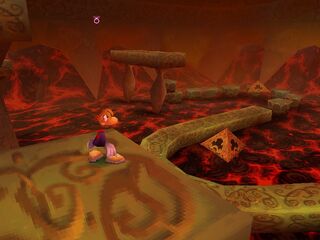 A new area in the Sanctuary of Stone and Fire.


Levels

Many of the levels are heavily altered from other versions. The most notable ones are Whale Bay (which has been merged with the Sanctuary of Water and Ice), the Sanctuary of Stone and Fire (featuring all new sections, while also removing some) and the Crow's Nest. After finishing the Crow's Nest there is a playable level from the cancelled 2D prototype, only unlocked if 90% of the Yellow Lums have been collected.
- The Clearing
- The Fairy Glade
- The Marshes of Awakening
- The Bayou
- The Walk of Life (sublevel)
- Whale Bay
- The Menhir Hills
- The Cave of Bad Dreams (sublevel)
- The Canopy
- The Sanctuary of Stone and Fire
- The Echoing Caves
- The Precipice
- The Sanctuary of Rock and Lava
- The Walk of Power (sublevel)
- Beneath the Sanctuary of Rock and Lava
- Tomb of the Ancients
- The Gloomy Island
- The Prison Ship
- The Crow's Nest
- A level from the cancelled 2D prototype
Cut level
In 2018 it was discovered that the PlayStation version contains a reference to a level by the name the Walk of Bravery, which was meant to appear between the Echoing Caves and the Precipice. Not much is known about this level, although the name was translated into all available languages. Judging by the name it was most likely meant to be similar in style to the Walk of Life and the Walk of Power.
Cancelled 2D prototype level

Main article: Rayman 2 (cancelled prototype)
There is a secret level from the original 2D version of Rayman 2 that can be played if the player collects 720 of the 800 Yellow Lums and completes the final boss fight in the Crow's Nest. The gameplay is similar to that of the original Rayman game. Rayman must travel from the foreground jungle landscape to the background landscape, battling early versions of the Robo-Pirates and a Robot Dinosaur. Elements from the original Rayman game appear in the level, like the Big Power, life, water lily and the end-of-level exit sign.
PocketStation functionality
The game was originally going to release with several PocketStation minigames. Due to the PocketStation not having launched outside of Japan by the time of the game's release, it was going to be locked behind a cheat code which would be revealed in case a global release ever was to happen.[2] Various preview articles mention the connectivity, also stating that the minigames would allow the player to collect lums from the game and fight its bosses.[3][4] However, due to unknown reasons, the functionality was never included in the final retail release. Leftovers can still be found in the game's demos, which include the full PocketStation menu, along with the functionality for downloading the minigames, which would use up 12 blocks. The actual data for the minigames is however not present in the demos and accessing the menu through cheats will only cause it to download random data from the console's memory.
External links
See also
References
- ↑ Australian Station issue 16, page 58, https://archive.org/details/australian-station-16-october-2000/page/58/mode/1up
- ↑ PSExtreme issue 57, page 45, https://archive.org/details/psextreme-issue-57-august-2000/page/n43/mode/2up
- ↑ GameSpot, Rayman 2 Preview, https://www.gamespot.com/articles/rayman-2-preview/1100-2558141
- ↑ IGN, 'Rayman 2: The Great Escape, https://www.ign.com/articles/2000/05/02/rayman-2-the-great-escape-2