Rayman (cancelled prototype)
- This article is about the cancelled SNES build of the game. For the early production of the final game, see Rayman (early production).

Before being developed for the Atari Jaguar, Sony PlayStation, Sega Saturn, and PC, the original Rayman game began as a project for the Super Nintendo Entertainment System. Information regarding this early iteration of the game was unveiled through various materials, including a Pix 'N Love article, scans from The Bible of Game Design in the book L'Histoire de Rayman, and from Michel Ancel himself, who also shared an early ROM of the prototype.
Plot
At the beginning of its development, the original Rayman game had a very different plot. This prototype version followed Jimmy, a boy who created a world on his computer called Hereitscool. When Hereitscool becomes infected with a virus, Jimmy enters his virtual world and takes on the persona of Rayman in order to defeat the virus.
Pix 'N Love article

On the 4th of July 2010, French retro-gaming magazine Pix’N Love revealed that, at the very beginning of its development, the original Rayman game was intended to be released for the Super Nintendo Entertainment System. The magazine also contained an interview with Rayman creator Michel Ancel on the subject. This version of the game featured a two-player co-operative mode, in which one player controlled Rayman and the other player controlled what appears to be a female version of Rayman, not dissimilar from the girlfriend character Simohne once planned to appear in Rayman Rayman Raving Rabbids. Rayman's body is red rather than the purple used in the final game, and the girl's body is blue. Both characters look considerably bulkier than Rayman's final appearance. Three screenshots of the prototype (visible to the right) are currently available, and they show early versions of the Dream Forest and the Caves of Skops. One image shows the heroes battling against an early version of Mr Skops. There are glimpses of what appear to be early versions of Antitoons, plums, flying rings, Tings, mushrooms, Big Powers and the telescopic fist.
One of the screenshots shows a heads-up display which is completely different from the one used in the final game or either of the Atari Jaguar prototypes. This display shows both characters' heads, each with their own ‘Shield’ and ‘Power’ status indicated by bars. Rayman's section of the display shows a picture of a pink crystal with the name ‘Skops’ above it, and the girl's section of the display shows a question mark where the crystal can be displayed. The ‘Shield’ bar appears to indicate the characters' health, but the function of the ‘Power’ bar and the crystals remains unknown.

With the advent of more powerful, optical disc-based games systems, the SNES version of Rayman, though nearing completion, was cancelled. The game was reworked for the newer platforms, and became the Rayman which is known today.
The Bible of Game Design
The book L'Histoire de Rayman, published in October 2014, features scans of 11 pages from The Bible of Game Design, a book written by Michel Ancel and Frédéric Houde to present the project to Ubisoft.[1] The book in its entirety was later featured in the Rayman 30th Anniversary Edition collection, containing general information about the game, its level design, and numerous artworks.
This design document, under the section "descriptif du personnage" (character description), reveals Rayman's original backstory as an electronic character created by a Professor Hendrix for his nephew, Jim, who travels through "virtual worlds". It lists his abilities, which include controlling objects from a distance with his fist, piloting flying engines, changing size, hanging, and crawling. A significant weakness is noted: his electronic nature prevents him from diving into water. The document also details the game's item system, separating "energy capsules" for health recovery (allowing him to withstand falls, fire, lasers, and other hazards) from "power capsules" used to augment his fist and gain special powers. These powers include the "magic fist" (a basic power to destroy walls), invisibility, the "energy ball" (a bouncing projectile), the "shield" (three rotating spheres protecting him), and the "Raydance" (a move to paralyze enemies). The text concludes by describing the planned heads-up display, which would feature gauges for energy and power, icons for available powers, and an additional gauge for "important monsters".
CHARACTER DESCRIPTIONRAYMAN is an electronic character created by professor HENDRIX for his nephew JIM. He travels through virtual worlds and has exceptional powers. He can control objects at a distance with his fist, pilot flying engines, change size, hang and crawl under platforms, and so on. He also has special powers with surprising effects. Despite these qualities, Rayman's electronic nature does not permit him to dive into water.
To recover he uses energy capsules. He can then withstand harder hits, for example:
- A fall from more than 8 times his size
- Contact with strong electric charges
- Contact with fire
- Being crushed
- Lasers, bombs, rocks, punches...
Thanks to power capsules, RAYMAN can augment the power of his fist and acquire special powers.
- The magic fist: the basic power, it allows you to destroy certain walls. It stacks with other powers.
- Invisibility: RAYMAN is invisible; he does not fear enemies.
- The Energy Ball: A sphere that bounces off the scenery and destroys enemies.
- The shield: Three spheres circle around RAYMAN and destroy his adversaries.
- The RAYDANCE: A dance that paralyzes his enemies.
RAYMAN's energy and power are represented with gauges. The available power and the selected object are represented by icons. For important monsters, an additional gauge is displayed on the right of the screen.
The book also details the project's work calendar, which lays out a 58-week development schedule, and another section describes the "repartition room", a half-sphere-shaped hub world with six gates that provide access to each of the game's sectors: control, music, energy, image, memory and synchronization. Drawings from the book show that the music sector is already very similar to Band Land, featuring numerous musical instruments and enemies present in the final game such as mad drummers, moths and cymbals. The synchronization sector, which is described as "controlled by the virus", corresponds to Candy Château, described in the work calendar as "the virus's lair: cake, circus and flipper"; a drawing of its level design also shows an environment very similar to that of the final game. The image sector is likely Picture City, but the scans contain no additional details about it. The book also mentions a "world of charms" and "Mandibulax", likely a boss enemy.
WORK CALENDAR5 weeks: Getting used to the SNES + preparation of utilities
- Creation of the map editor
- Creation of the sprite editor
- Creation of the KERNEL 65816 SNES
- Study of the SNES characteristics (65816, Scrolls, Sprites, Interrupts...)
3 weeks: Creation of the RAYMAN character functions
- Character movement
- Animation
- Creation of following Rayman in an environment
2 weeks: Putting Rayman in a scrolling environment, with collision detection for jumps
RAYMAN IS THEN CAPABLE OF MOVING CORRECTLY IN AN ENVIRONMENT
3 weeks: Creation of step 1 (Getting used to everything + diverse)
3 weeks: Creation of step 2 (Capture + scooter)
7 weeks: Creation of step 3 (The world of charms)
5 weeks: Creation of step 4 (Disguise + combat + recovery zone + combat Virus 1)
4 weeks: Creation of step 5 (Sector IMAGE)
6 weeks: Creation of step 6 (Sector MUSIC)
5 weeks: Creation of step 7 (Sector ENERGY)
3 weeks: Creation of step 8 (Mandibulax)
6 weeks: Creation of step 9 (The virus's lair: Cake, circus and flipper)
3 weeks: Creation of step 10 (Virus end)
3 weeks: Creation of the intro and ending of the game
That makes a total of 58 weeks of development.
SCENE 4NAME: THE REPARTITION ROOM
DESCRIPTION: A large room in the shape of a half-sphere in which there are 6 gates, with 6 symbols below them. The symbol for each accessible gate is a luminous relief, contrary to the closed gates. At this stage of the game 2 gates are accessible: the gate to the control sector (where we came from) and the gate to the synchro sector. But it seems the gate to memory sector is completely destroyed.
SEQUENCE OF EVENTS:
- 1_AC: Gate to the control sector (where RAYMAN came from)
- 2_AC: Gate to the MUSIC sector (closed)
- 3_AC: Gate to the ENERGY sector (closed)
- 4_AC: Gate to the IMAGE sector (closed)
- 5_AC: Gate to the MEMORY sector (destroyed whereas RAYMAN had to go there)
- 6_AC: Only the gate to the synchro sector is open. RAYMAN has no choice but to enter this sector controlled by the Virus.
Other drawings from the book include level designs, monster concepts (such as a phase of the virus from the final scene as a large blob with three giant mosquito faces), and images of the game's intro, showing Professor Hendrix in his workshop.
Video Games You Will Never Play article
On the 30th of August 2016, Unseen64 released a compendium of articles about unreleased games in their book Video Games You Will Never Play. In the article about the cancelled SNES version of the original Rayman, further details about the game and its story were revealed. The character of Rayman was revealed to have been developed by Jimmy's uncle Professor Hendrix, and in the midst of a storm, lightning struck Jimmy's house, transforming him into Rayman through the AC power socket, which also gave him his signature circle on his clothing. It was also revealed that this iteration of the game was originally a solo project by Michel Ancel for the Atari ST, before moving to the SNES CD addon after he was joined by Frédéric Houde. Four screenshots of the SNES version were included with the article.
-
 Rayman in an underground area of what appears to be an early version of the Dream Forest. An unknown scorpion enemy as well as what appears to be an early version of the spider enemy are shown.
 -

-
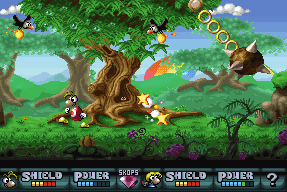 Rayman in what appears to be an early version of the Dream Forest. Two unknown black bird enemies and a wrecking-ball hazard are shown.
 -
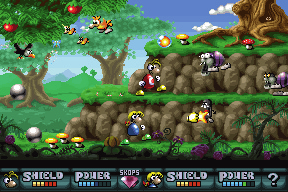 Rayman and his female counterpart in what appears to be an early version of the Dream Forest. The aforementioned black bird enemy appears again, alongside a yellow bird enemy with two smaller counterparts, an early version of an Antitoon and the same spider enemy from the first image.


Answers from Michel Ancel
During a live stream of Rayman Legends, Michel Ancel replied to a question concerning the SNES version of the original Rayman. He stated that he was only in a team of two at the time the Super Nintendo version was being made, and that he was 'super excited', it being the first platform he'd ever worked on directly. It was painful and extensive procedure to build the game onto the cartridge though, and since he eventually got the full team together, the Super Nintendo couldn't do it justice.
On the 18th of October 2016, Michel Ancel posted two partial screenshots from the SNES version of the original Rayman, confirming that the game was never completed and adding that it was lost forever.[2] However, on the 23rd he announced that a cartridge containing an early version of the game from this stage of development was found by Frédéric Houde, this cartridge was stated to have been from 1992,[3][4] and managed to make it work. He then posted a photograph of a previously unseen world contained in the game.[5] Ancel later revealed that at this stage, the game initially took place in a computer, with Rayman being one of its employees, the main villain at this point was intended to be a computer virus.[6]

-
 The first partial screenshot posted by Michel Ancel, not seen anywhere before.
 -
 The second partial screenshot posted by Michel Ancel, part of one of those published in Pix’N Love.


Dumped ROM
On the 3rd of July 2017, an early ROM was dumped[7] with a short gameplay segment as previously shown by Michel Ancel. In the ROM, the player can jump and trigger animations, which will also automatically start if the player does not move. The player can also move faster and start an animation with a charging fist.
On February 13, 2026, this ROM was officially published for the first time as part of the Rayman 30th Anniversary Edition compilation.
-
 The full map in the prototype

-
 The level starts with Rayman falling down.
 -
 The start of the level.
 -

-
 The fist turning gold.
 -
 An animation with a music box.
 -
 Rayman with an open mouth.
 -
 A pipe the player will go through when jumping into it.
 -
 The top of the pipe from where it is solid.
 -
 This stunned animation is triggered from jumping from a high distance.
 -
 Another jumping animation.
 -
 Some transparent material.
 -
 The end of the level.


007.png)

Unused sprites


External links
References
- ↑ L'Histoire de Rayman, Chapter 2 - Rayman, un projet humain et technique
- ↑ Instagram, @michelancel, https://www.instagram.com/p/BLt6dsUgODo/, « Pixel lovers ... Did this 25 years ago , the game was playable on the Super nintendo console but was never finished + We've lost the build . All these pixels are lost , like tears in the rain ... »
- ↑ Instagram, @michelancel, https://www.instagram.com/p/BL5fSliA2bD/, « Incroyable !!!! We have found the old unique Rayman SNES ROM !!!! It was sleeping for 24 years ..... Time to wake it up !!!! »
- ↑ Instagram, @michelancel, https://www.instagram.com/p/BL_wNhGALF8/ « Rayman SNES in motion . The little ugly guy is alive after a 24 years night . This ROM might be the first one we burnt and contains very few stuff . We might find more ROM with other early prototypes . I just need to convice Fred, the coder who revealed their existence to continue the search in his vast and dangerous attic. Man, this is electronic archeology ! »
- ↑ Instagram, @michelancel, https://www.instagram.com/p/BL5f5XIAfa5/, « It's working !!!! 4 people in the world have seen this . We thought it was lost , but somewhere in the cold electronic circuit , something was still alive . and running at full 60fps !!! should do a Switch version of this 😂 »
- ↑ Instagram, @michelancel, https://www.instagram.com/p/BL_wNhGALF8, « You're right ! Original game was taking place in a computer and the big villain was a computer virus . Rayman was just an employee in this big computer »
- ↑ Twitter, @ocornut, https://twitter.com/ocornut/status/881876378056085505, « I've dumped a prototype demo of unreleased Rayman for SNES, here it is! (NB: very early dev build, not a full game) »
|
|
Cancelled Rayman games |
