Tibetan: Difference between revisions
Added information and minor improvements |
Hunchman801 (talk | contribs) Added language links |
||
| (9 intermediate revisions by 2 users not shown) | |||
| Line 1: | Line 1: | ||
{{Character | {{Character | ||
| name = | | name = Tibetan | ||
| image = [[ | | image = [[File:R1 site Monk.jpg|center|200px]] | ||
| alignment = Good | | alignment = Good | ||
| appears in = ''[[Rayman 1|Rayman]]'', ''[[Rayman | | appears in = ''[[Rayman 1|Rayman]]'', ''[[Maths and English with Rayman]]'', ''[[Rayman Designer]]'', ''[[Rayman Activity Centre]]'' | ||
| species = Unknown | | species = Unknown | ||
| status = Background character | | status = Background character | ||
}} | }} | ||
[[ | [[File:MoineGrosseBoule.png|thumb|320px|left|class=sprite|A Tibetan juggling a large blue sphere.]] | ||
{{ | {{Quote|text=This is a wise old Tibetan. He'll make you discover musical instruments, rhythms and melodies, and he will tell you some beautiful rhymes.|sign=Official site|source=''[[Maths and English with Rayman]]''<ref>''Rayman Junior'' official site, Le sage Tibétain, http://web.archive.org/web/20020608132643/http://sites.ubisoft.fr/raymanedu/ami/ami2/sage.html</ref>}} | ||
'''Tibetans''', also known as '''Tibetan sages''' and '''monks''', are an order of meditative, pacific giants found only in [[Band Land]], the second environment visited in [[Rayman 1|the original ''Rayman'' game]]. They wear red-and-yellow robes and caps. Like [[Rayman]], they have no arms, and their hands float disconnected from their bodies. However, they do appear to have legs and necks, making them only partially limbless. In ''[[Rayman Activity Centre]]'', a drawing of a Tibetan without a neck appears. [[The Magician]] claims that this is one of his friends. They are always seen sitting, cross-legged, floating in the air. They are found primarily in the cloudy reaches of [[Gong Heights]], though a few can be found in [[Allegro Presto]], and in the first part of [[Mr Sax's Hullaballoo]], which combines elements from all of the [[Band Land]] levels. The Tibetans' eyes are always closed and their mouths always form relaxed smiles. As they meditate, most Tibetans bring [[bongo]]s back and forth in a steady rhythm; when the [[bongo]]s are held in front of the Tibetans' faces, they appear to form scowling patterns. As [[Rayman]] progresses, he begins to encounter Tibetans who hold groups of six connected blue orbs which resemble giant [[Ting]]s. Eventually he comes across Tibetans who juggle gigantic blue spheres between their hands and head. When the blue spheres are examined closely, they appear to show a reflection of a smiling [[cloud]] in the sky. [[Rayman]] can use the [[bongo]]s and both the large and small blue spheres as platforms. | |||
< | <gallery widths="316px" heights="200px" class="sprite"> | ||
MoineBongosHaut.png|A Tibetan holding two [[bongo]]s. | |||
MoineBongosBas.png|The same Tibetan moving the [[bongo]]s. | |||
MoineBoulesHaut.png|A Tibetan holding six connected blue orbs. | |||
MoineBoulesBas.png|The same Tibetan now holding one blue orb. | |||
</gallery> | |||
==Names in other languages== | |||
{{Names | |||
|en=Tibetan | |||
|fr=Tibétain | |||
|fr_S=''[[Rayman Designer]]'' | |||
|fr_2=Sage Tibétain | |||
|fr_2_S=''[[Maths and English with Rayman]]'' website | |||
|de=Tibetaner | |||
}} | |||
==References== | ==References== | ||
| Line 28: | Line 37: | ||
[[fr:Moine]] | [[fr:Moine]] | ||
[[hu:Szerzetes]] | |||
[[pl:Mnich]] | [[pl:Mnich]] | ||
[[zh:藏僧]] | |||
[[Category:Friends from Rayman 1]] | [[Category:Friends from Rayman 1]] | ||
Latest revision as of 18:12, 17 February 2026
| Tibetan | |
|---|---|
 | |
| Alignment | Good |
| Appears in | Rayman, Maths and English with Rayman, Rayman Designer, Rayman Activity Centre |
| Species | Unknown |
| Status | Background character |

This is a wise old Tibetan. He'll make you discover musical instruments, rhythms and melodies, and he will tell you some beautiful rhymes.—Official site, Maths and English with Rayman[1]
Tibetans, also known as Tibetan sages and monks, are an order of meditative, pacific giants found only in Band Land, the second environment visited in the original Rayman game. They wear red-and-yellow robes and caps. Like Rayman, they have no arms, and their hands float disconnected from their bodies. However, they do appear to have legs and necks, making them only partially limbless. In Rayman Activity Centre, a drawing of a Tibetan without a neck appears. The Magician claims that this is one of his friends. They are always seen sitting, cross-legged, floating in the air. They are found primarily in the cloudy reaches of Gong Heights, though a few can be found in Allegro Presto, and in the first part of Mr Sax's Hullaballoo, which combines elements from all of the Band Land levels. The Tibetans' eyes are always closed and their mouths always form relaxed smiles. As they meditate, most Tibetans bring bongos back and forth in a steady rhythm; when the bongos are held in front of the Tibetans' faces, they appear to form scowling patterns. As Rayman progresses, he begins to encounter Tibetans who hold groups of six connected blue orbs which resemble giant Tings. Eventually he comes across Tibetans who juggle gigantic blue spheres between their hands and head. When the blue spheres are examined closely, they appear to show a reflection of a smiling cloud in the sky. Rayman can use the bongos and both the large and small blue spheres as platforms.
-
 A Tibetan holding two bongos.
 -
 The same Tibetan moving the bongos.
 -
 A Tibetan holding six connected blue orbs.
 -
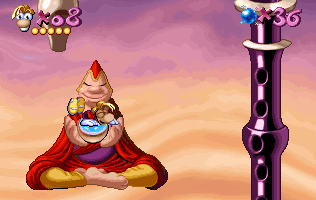 The same Tibetan now holding one blue orb.


Names in other languages
| Language | Name |
|---|---|
| English | Tibetan |
| French | Tibétain (Rayman Designer)
Sage Tibétain (Maths and English with Rayman website) |
| German | Tibetaner |
References
- ↑ Rayman Junior official site, Le sage Tibétain, http://web.archive.org/web/20020608132643/http://sites.ubisoft.fr/raymanedu/ami/ami2/sage.html